Summary
Parkinson’s Disease (PD) presents several challenges to oral health, due to the physical, psychological, and iatrogenic patterns associated with the disease. Patients often suffer from orofacial and dental problems exacerbated by conditions such as xerostomia (dry mouth) and sialorrhea (drooling). Additionally, due to motor difficulties, cognitive deficiencies, and behavioral changes, PD patients often struggle with oral hygiene, which can lead to increased risk of dental diseases. The maintenance of oral health is vital for the overall quality of life of PD patients. Therefore, specialized strategies and tools for oral care, including electric toothbrushes, gels, and sprays, are recommended for individuals with PD. Caregivers play a crucial role in supporting PD patients in maintaining good oral hygiene, and home training programs and personalized instructions from dental practitioners are beneficial for improving oral health. The use of assistive devices and the scheduling of dental appointments during symptom-controlled periods are also recommended for PD patients.
Oral Health Challenges in Parkinson’s Patients
Parkinson’s Disease (PD) poses several challenges to maintaining oral health. The physical, psychological, and iatrogenic patterns associated with PD often lead to diminished oral health. PD severity and duration are both linked to increased severity of orofacial and dental problems, largely due to motor difficulties, cognitive deficiencies, and behavioral changes affecting daily oral care. This decline in oral health, in turn, leads to a decline in overall quality of life.
PD patients often present a variety of oral diseases that can be exacerbated by xerostomia (dry mouth) and sialorrhea (drooling). These conditions are complicated by the patients’ physical limitations, such as rigidity and tremor, which can hinder the effectiveness of oral care by general dental surgeons. Moreover, PD patients are more prone to falls, which can lead to additional oral health issues.
PD is also associated with hyposalivation, which can result in significant taste disturbance and other oral health problems like tooth wear, oral soft tissue lesions, dental caries, candidiasis, and periodontal disease. Almost 65% of PD patients in a study reported xerostomia, confirming that xerostomia and hyposalivation are prevalent complications of PD.
Another common challenge is maintaining oral hygiene due to dyskinesia of the hands and/or face, making PD patients a high-risk group for caries and periodontal disease. As PD progresses, patients’ chewing ability often decreases, further exacerbating oral health issues. Despite the use of electric toothbrushes, dental floss, and stannous fluoride, PD patients generally maintain lower levels of oral hygiene than the general population.
Some patients with PD take medications for unrelated diseases that suppress the immune system or clozapine for PD-related psychosis, which can significantly reduce white blood cells, increasing the risk for bacteria-causing dental diseases to spread. Poor dental and oral health can also make it hard for patients to eat enough or get the right balance of nutrients, further impacting overall health and well-being.
Therefore, these oral health challenges demand more attention worldwide from multidisciplinary PD medical management teams and standard referrals to oral health-care providers.
Essential Oral Care Strategies for Parkinson’s Patients
Maintaining good oral hygiene is important for people with Parkinson’s disease, as it improves their quality of life. To improve oral hygiene and comfort, a range of oral healthcare tools and symptom-relieving products are available. This includes electric toothbrushes, gels, and sprays. Patients’ choices should be informed by the advice of their dental team and pharmacist.
Importance of Caregivers
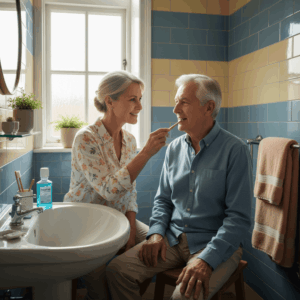
Caregivers play a crucial role in supporting and maintaining the good oral hygiene of Parkinson’s patients. The dental and movement disorder teams should motivate and educate them to maintain good oral hygiene routines at home. Demonstrations, verbal and written instructions, and positive reinforcement are proven to be effective.
Home Training and Oral Hygiene Programs
These programs are a beneficial addition to traditional oral care strategies. They have been proven successful and can include training in jaw mobility, masticatory function, and lip and cheek muscles. Moreover, they may involve the use of special toothbrushes, denture brushes, interdental brushes, and flossing. Home visiting dental services for dental check-ups and education could also help Parkinson’s patients who struggle to receive these services at dental clinics.
Personalized Instructions
It is vital for dental practitioners to focus on providing specific and personalized instructions, considering the poor oral conditions of patients with Parkinson’s disease. These instructions should be simple enough to be easily delivered to caregivers. Moreover, patients should be encouraged to use electric toothbrushes as they are proven to be more effective.
Scheduling and Preparation for Dental Appointments
Patients should provide their dentists with their complete health details. If they experience difficulty with certain dental care practices, such as flossing or using fluoride rinses, their dentist may suggest alternatives. Scheduling dental appointments when their symptoms are most effectively controlled is advisable. Consistent dental maintenance helps prevent cavities and gum disease.
Use of Assistive Devices
Assistive devices can help patients maintain good oral hygiene. These include Oral swabs to clear the mouth of food, and suction bulbs or portable oral suction devices. Assistive devices for transportation and prevention of unnecessary falls are also available for Parkinson’s patients.
Evidence-Based Recommendations for Oral Care in Parkinson’s Patients
The importance of maintaining good oral health for patients with Parkinson’s Disease (PD) cannot be overstated, as it directly impacts their quality of life. A review conducted by researchers in Brazil indicates a significant correlation between Parkinson’s disease and oral health, stressing the importance of proper oral hygiene and caregiver’s role in supporting and maintaining it.
Recent studies examined the oral health status of PD patients in comparison to a control group and found that oral health is related to the duration and severity of PD. The analysis was conducted with 74 PD patients and 74 controls, encompassing a comprehensive review and drawing new hypotheses. These investigations reveal weakened oral health, reduced oral care, and the appearance of orofacial manifestations in PD patients.
Furthermore, the studies shed light on the profound impact oral health disorders can have on the quality of life and PD progression. Consequently, they highlight the need for home training and oral hygiene programs. Such programs, if properly implemented, can be successful in improving jaw mobility, masticatory function, and muscle strength in the lips and cheeks. Utilization of special dental tools such as toothbrushes, denture brushes, interdental brushes, and floss can also significantly improve oral health. Home visiting dental services for regular check-ups and oral hygiene education have also been suggested, especially for PD patients who face difficulties in receiving these services at dental clinics.
Assistive devices such as oral swabs and portable oral suction devices have also been recommended to aid PD patients in maintaining good oral hygiene and clearing the mouth of food. Sarah, a dynamic individual committed to addressing unmet needs, has designed programs and led training aimed at enhancing the oral hygiene of PD patients. These strategies underscore the importance of specific care needed by PD patients for maintaining good oral health.
Role of Caregivers in Oral Care
Caregivers play a critical role in the oral health management of patients with Parkinson’s disease (PD). Due to the challenges faced by PD patients in maintaining home oral hygiene, there is a need for specific oral care strategies to address these issues. These strategies can involve various interventions, such as home training, the use of special oral care tools, and even professional home visiting dental services.
Home training and oral hygiene programs can be particularly effective, and have proven successful when implemented properly. These programs can cover various aspects, such as training on jaw mobility, masticatory function, and the proper use of special oral hygiene tools such as toothbrushes, denture brushes, interdental brushes and floss.
Additionally, there are a number of assistive devices and adaptive equipment available that can aid in maintaining good hygiene. These can be particularly useful in not only maintaining the independence of the patient, but also reducing the burden on the caregiver.
In some cases, the use of domiciliary professional oral care services can be beneficial. These services, which involve regular professional toothbrushing at home, could potentially improve the quality of oral hygiene, and in turn, contribute to better nutritional status and overall quality of life. However, the effectiveness of this approach in PD patients is yet to be conclusively demonstrated.
It’s also important to note that the dental care, follow-up, and treatment provided to each patient must be patient-specific. Factors such as the stage of Parkinson’s disease, motor features, comorbidities, medications and psychosocial factors should all be taken into consideration when designing a dental care plan. Individualized treatment plans have been proven successful in complex cases, and these cases should serve as encouragement for clinicians to adopt a similar approach.
The content is provided by Avery Redwood, Lifelong Health Tips